AI Watermarks: Does Your Website Copy Need A Rewrite?
If you liked this, Pin to Pinterest, or save for later.
Does AI-Written Content Now Carry a Watermark?
If you’ve been using AI to write or tidy up your website copy, Squarespace blog posts, or other content, you might be wondering if you’re in a bit of a pickle. And I totally understand that.
Quick answers:
Yes, AI watermarks exist.
Words can’t gain a watermark after the fact, but words written with Gemini since 2024 already carry Google’s watermark. Either way, how your words sound matters far more than any mark.
Your own voice is the answer.
Models such as Claude, ChatGPT, and Gemini at the time of writing, add an invisible AI watermark to text at the time of writing, and it does actually follow your words from chat into Notion, onto Squarespace, or other website platforms.
In this blog post, we’re going to cover:
What AI watermarks are
Where it follows your content: emails, code, images, and PDFs
Who can check and how
AI Watermarks vs AI detectors
Trust and Google
What should you tell site visitors about your use of AI
What about Squarespace’s AI Writer and Image Studio
Will AI content hurt your SEO
Whether to rewrite your content
How to make your words, yours
What An AI Watermark Is, In Simple Terms
An AI text watermark isn’t visible. And if you’re pondering; it’s not hidden code. It’s actually a pattern in word choices, and each AI company holds its own secret key.
It’s happening because the EU AI Act’s transparency rules, Article 50, came into effect on 2 August 2026. Already, Claude’s watermark applies worldwide; not every company has said the same.
I like to think of it this way. If you hold a sheet of good-quality writing paper up to the light, you’ll most likely see the paper mill’s watermark. This tells you who made the paper, not who wrote the letter. However, if the letter’s been signed by you and posted from your address, it’s yours anyway.
The watermark: it’s a hidden mark an AI company will add as words are being written.
The watermark checker: this is a tool that looks for that mark. It uses the company’s secret key. This is not public yet.
AI detectors: these are tools that guess from the writing style, with no key or watermark involved. This is out there now.
The watermark is not secretly tracking or naming you. But if you’ve published AI generated content on your site, it’s linked to you, watermark or not. So a positive check would say “AI was involved in this copy on such and such a site”, which is why your own voice really matters.
Claude’s watermark is built on Google DeepMind’s technology. This is the same system as Gemini uses, and it’s fast becoming the standard.
Does It Follow Your Words From Chat To Notion To Squarespace?
Yes, it follows your words.
It does, because the pattern is in the words, so copy-paste carries it across any platform. For Claude, every model released after 2 August 2026, carries the watermark by default, with no option for users to disable it. Older models are being updated gradually, so they too, will have a watermark, but this only applies to content that is written from now on, not from the past.
Companies that access Claude through Amazon (as opposed to the Claude app) will get the watermark a little later, with the rollout finishing late October 2026.
What weakens it? (you editing AI’s words).
Carrying out your own heavy editing, paraphrasing and translation. Very short passages are too short to carry it in the first place.
Brand voice won’t hide it.
You might say, well, I’ll just have AI write it and add in my brand voice. Sorry to say, but AI text is still AI text, and mixing AI text with your own proper rewrite weakens the mark, but won’t remove it.
What about AI proofreading your words?
A light grammar tidy-up, will probably be undetectable, but AI-rewritten paragraphs, would show.
Will Your Existing Blog Posts Be Watermarked?
No. Marking is never retroactive. At the point of AI-generation, a watermark is created. Nothing already published can gain one later on.
What’s watermarked depends on when, and with what, it was written. Text from new Claude models released from 2 August 2026 are marked. Older Claude models are still being added. Gemini text was marked at the time of writing.
Checking is backwards-looking. When public detection is here, it will be able to check anything that’s already marked, including text written today.
What About Emails, Code, Images and PDFs?
Emails
The same as any text. Less so if an email is under approx 150 words because it’s unlikely to be able to carry a reliable signal. Longer newsletters and proposals can.
Code
Claude Code will be watermarked, but short CSS snippets are probably a bit too small to carry much. Not officially documented.
Images and SVGs
This is a different system: C2PA “content credentials” (this is a digital “made by” label attached to the file). Claude doesn’t make photos or video, but can make icons and diagrams. This data can be lost on upload, including to social media. Your website platform may strip it too.
PDFs
Word docs and slides don’t get a file label, but longer AI-written text inside them still carries the word-level watermark.
Other AI Tools
Google, Meta and Microsoft, and Open AI, the makers of ChatGPT, have signed up to the EU’s code of practice, and each handles it differently. Google has used SynthID on text, images, audio and video since 2024.
The latest news, says that OpenAI, will add an invisible watermark to ChatGPT and Codex text in the EU. It’s not global, whereas Anthropic is applying Claude’s worldwide. Microsoft also seems to have started labelling content in CoPilot.
UK and US are not watermarked at the moment. The one exception is API customers can opt in to watermarked text for select models. This is relevant for businesses building their own tools.
Remember, no watermark doesn’t mean human-written.
Does This Apply In The UK and US?
Claude’s watermark applies in the UK, Ireland and the US, and California’s AI Transparency Act, covering AI images, video and audio (not text).
A watermark for ChatGPT is rolling out in Ireland and the EU over the course of few weeks as I type this in October 2026. Not for now in US and UK.
For Gemini, it’s likely for the UK and US, and present for Ireland and the EU.
What About Squarespace’s AI Writer and Image Studio?
Squarespace’s AI writer can generate website copy for your site. Squarespace Image Studio uses AI credits which come with your plan, and you can buy extra packs if you run out. You get 10 starter credits when you upgrade, plus monthly credits on Core, Plus and Advanced plans.
Squarespace has partnered with OpenAI (makers of ChatGPT), Anthropic (makers of Claude) and Google (makers of Gemini), but Squarespace doesn’t say which platform does what. However, since Claude doesn’t make photos, it’s reasonable to assume that Image Studio uses ChatGPT or Gemini behind the scenes. So, I’d assume anything made with Squarespace AI may carry a watermark or AI label, just like any other AI tool.
My advice for words:
As a Squarespace web designer and Squarespace Circle Member, I would only recommend using Squarespace’s AI writer, as a first-pass starting point, only. Remember, it doesn’t know your stories, your opinions, client or customer insights, your voice, and most importantly, what makes you, you. It’s this piece of the puzzle that builds trust and gets you found.
Early users have noted that generated text is generic and could feel bland, emotionless, or flat.
Take a read of my blog post for Why Brand Voice Matters.
My advice for images:
I’d always recommend using your own photos for anything unique to you, like product photos and headshots. There’s always the risk that AI images may put potential clients or customers off.
Image Studio designs may look polished and on trend, but that isn’t the same as your brand. Squarespace’s recommendation is the same as mine, use your own photos for anything unique.
Lastly, Squarespace’s terms do say that users are ultimately responsible for any AI content they publish on their site.
Who Can Check, and How?
Currently, there isn’t a public checker; Claude’s watermark detection is limited to regulators, researchers, media and other eligible organisations. There isn’t a public date for this, at the moment.
However, the marking is happening now, even if the checking isn’t. For instance, every new bit piece of Claude-written content carries the mark today.
When public detection arrives, it will work on content written today. There’s no amnesty for content already marked before the checker launched. Old posts won’t gain a watermark (as we covered above). And just because there isn’t a public watermark checker today, doesn’t mean there are no checks, because detectors like Pangram are already working, on style rather than watermarks.
Anthropic is planning for a detection tool that other organisations can plug into. But it’ll be a deliberate check, which will probably be built into other tools (think about plagiarism checkers or publishing platforms).
I would warn against anyone selling a Claude watermark checker or remover, because they can’t back it up, because Anthropic holds the key.
The exception to this is images (see above). They have a C2PA label that can already be checked if the label’s still attached.
AI Watermarks vs AI Detectors
The AI-detection tools that schools and businesses are already using can’t read Claude’s watermark, because detection needs Anthropic’s secret key.
You might have heard of Pangram, an AI detector. This type of detector doesn’t read watermarks; instead they recognise the style of AI generated writing. AI detectors don’t care where you live.
Pangram does well for independent tests on longer text; but it’s less reliable on short text. It can also be fooled by “humaniser” tools, and can flag users who used AI to polish their own writing. So, think of a detector score as a strong clue, but not proof.
So, even with no watermark, heavily AI-polished words can still read as AI, to a tool and to a human.
Will An AI Watermark Hurt Your SEO?
Google states it will judge quality, not the tool, so no penalty.
As you can see from the screenshot, Google says that it is still about ‘rewarding high-quality content, however it is produced’. Here’s the link to this Google article on AI-generated content.
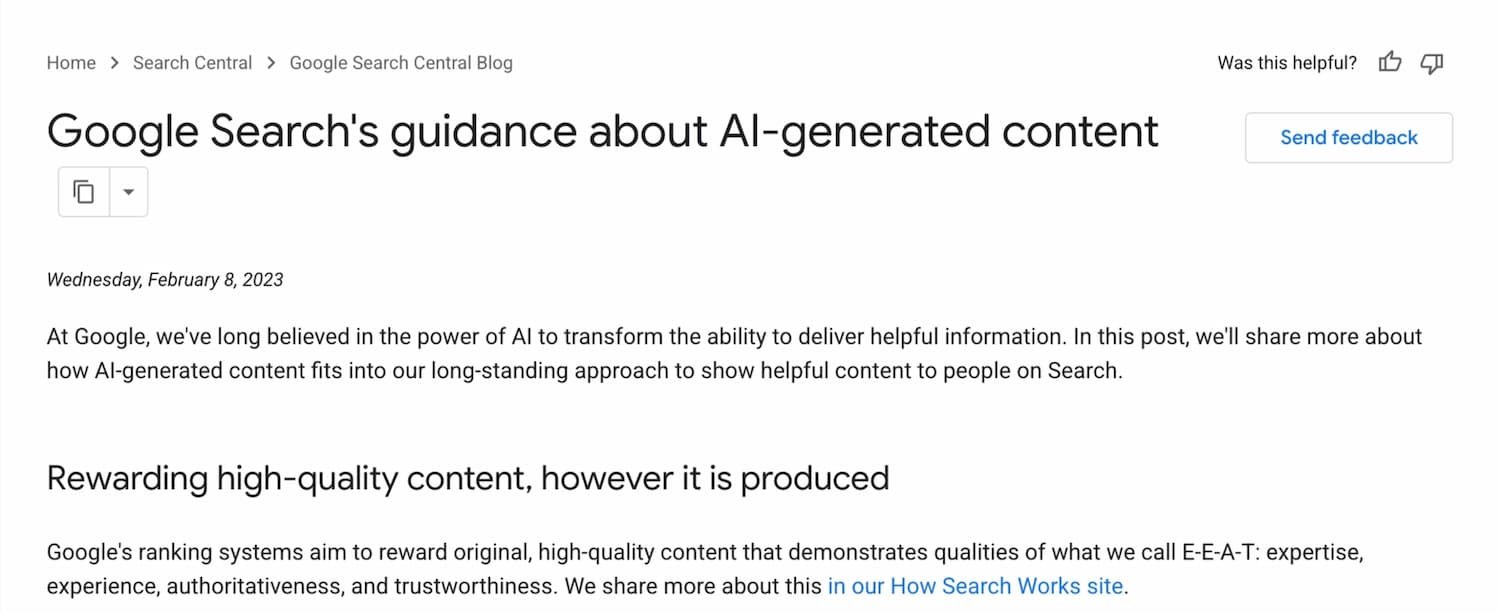
Google is keen to reward high-quality content that demonstrates qualities of what they call E-E-A-T in other words: experience, expertise, authority, trust.
And remember, real photos are also a big win for brand trust because they show experience, the first “E” in E-E-A-T.
Google SEO and AIO are about getting your site found. And therefore, sites with real experience and original thinking are rewarded, so use your brand voice to get found and cited.
“AI overviews that cite a page get roughly double the click-through of those that don’t (about 2.1% vs 0.9%).”
The Real Trust Question
You might be thinking: “If nobody can check, why should I care?” or at the other end of the debate, “Should I just stop using AI?” I’d say, not necessarily, it’s how you use it.
For example, I had a client come to me with AI generated text, and honestly, we had to pull it apart and start again. It sounded so corporate and unemotional. My client is actually very approachable, friendly, and knowledgeable, but the text generated, didn’t sound like her or do a good enough job of separating her from other people doing similar work. It lacked personality and human warmth.
Already, researchers are describing this as the largest real-world test so far of how people react to AI watermarking. Some concerns include whether it lowers quality, secretly identifies people, or can be easily removed.
The bigger picture comes down to trust. No, a reader can’t see a watermark, but the content could feel very generic and generic copy could have been written by anyone, about anyone.
As I’ve said, the watermark only says AI was involved and that could be from writing a whole post to fixing some punctuation. At the end of the day, it’s about transparency and authenticity. It’s not a verdict ‘against you’.
I feel trust and authenticity is so important these days, so knowing content has been written by that particular person, does mean a lot. If you want to go a step further, consider writing an AI policy and link to the page in your footer, so it’s easy to see.
Should You Rewrite Your Old Content?
I’d suggest not doing a full rewrite for the watermark. However, a light voice audit check would be useful.
Here are some steps:
Your most important pages first: Homepage, About, Services and Contact pages
Next, your top 5-10 blog posts by traffic (see Google Search Console or Squarespace Analytics)
Ask: do these words sound like me? Have I included a real example, opinion, or client story?
Where is the content thin? Add to it rather than rewrite: include a relevant personal or client/customer story, your angle on a topic, a “what I’d do” section
Unless outdated, just leave low-traffic, older posts
Tip: If you do end up using Blueprint AI placeholder copy, the AI writer, Image Studio, AI section backgrounds, AI product descriptions, or the Clarkson AI chat assistant, I’d have a quick look at these spots on your site and check through everything before those pages go live. Ask yourself, does it sound like you, is it accurate, and have you rewritten any generic placeholder text? And, if your site is already live, pop back in and follow the same checks.
Should You Tell People / Your Website Visitors You Use AI?
I’d say this was optional for a marketing blog, but for most small business owners and personal brands, a short, confident statement can build / maintain trust.
In case you’re wondering, Google’s guidance says disclosure can be useful where readers would reasonably wonder how content was made. It’s about readers, not Google tracking it.
For businesses in the EU (including Ireland) that are publishing content on matters of public interest, there may be extra duties, so check with a legal adviser.
How I Keep My Words Mine
I may ask AI for an outline and any associated facts and data points (that I then check)
I will write the draft myself, imperfectly
I may ask for feedback, but not rewrites
I will add any brand, client, or personal stories, opinion, or local detail
I will keep headlines and calls to action my own
I’ll read content aloud before publishing, so I know it sounds and feels like moi!
Frequently Asked Questions
A few quick answers to the questions that come up most.
-
Yes, in the EU from October 2026. It’s rolling out over a few weeks. Not yet in the UK and US; but remember, no watermark, doesn’t mean human written.
-
I’d steer clear of “remover” sellers, because they don’t own the secret key. Instead, rewrite in your own words.
-
Squarespace hasn’t said; but assume it may, as it’s powered by OpenAI, Anthropic and Google.
-
Not in itself, however generic content is. However, real experience gets you found and cited.
-
Nope. Pangram is an AI detector that works by recognising the style of AI generated writing and giving a score. It’s a clue but not proof. However, an AI watermark is only detected because of a secret key.
-
Claude: yes and worldwide.
ChatGPT: EU only, for now.
Gemini worldwide since 2024.
California act: covers images, video, audio.
The Takeaway 🌿
The watermark isn’t the ‘big bad wolf’. Instead, it’s robotic/generic content, without personality.
However, I’d recommend not waiting for the public checker to arrive before your words sound like you.
If you’d like a Pro Website Audit & Strategy (£698, any platform) review whether your website actually sounds like you, feels authentic, shows your expertise and builds trust, I’d love to help you.


Join the HeartBiz Newsletter
Recent Blog Posts