Your Free Web Design Checklist for a Website That Actually Works
Looking for a web design checklist for small business websites that's actually useful, not just a list of buzzwords? You're in the right place. Grab my free, 12-page 5-Step Web Design Checklist below, and let's walk through exactly what makes a website hard-working, not just pretty.
I know your time is precious, and planning a new website (or a rebrand) can feel proper overwhelming — especially when you're mega busy, or web design and marketing just isn't your thing.
In this post, we'll cover:
What actually makes a website "hard-working" (hint: it's not just how it looks)
The 5 essential elements every small business website needs
Real stats on why this stuff matters more than you might think
Where to grab your free, downloadable checklist
Wherever you're at on your website journey, this checklist will guide you every step of the way — from enhancing user experience to boosting your SEO — covering the main tasks worth ticking off to build a website that's the real deal.
A well-designed website attracts and retains clients, builds your brand's credibility, and drives business growth.
Get Your Free 5-Step Web Design Checklist
Sign up below to get your 12-page download, including checklists, best practices, helpful tips and resources.

The 5-Step Web Design Checklist for a Website That Works as Hard as You Do
Right then — let's get into it. These are the five things I check, without fail, on every single client website I build.
1. What Makes a Website "Hard-Working"?
A hard-working, strategic website isn't just one that looks stunning — though that matters too. It's one that loads well, is secure, can be found reliably by your ideal clients (that's your SEO doing its job), and is responsive across every device, keeping visitors happy wherever they land.
Here's a stat worth sitting with: 94% of people form an opinion about a website based purely on its design — and they do it in around 0.05 seconds (Source: Digital Silk, 2026 Website Design Statistics). Blooming quick, isn't it? You genuinely don't get a second chance at that first impression.
Not sure whether you need a full rebrand or just a refresh? Have a read of Website Redesign vs. Rebranding to help you decide.
2. Clear Website Navigation: Guiding Your Visitors With Ease
A website with clear, intuitive navigation helps visitors find what they're looking for quickly, without a wobbly, confusing maze of menus. This reduces frustration and encourages people to actually stay and explore, rather than bouncing straight back to Google.
Simple, well-labelled menus, a visible search option where relevant, and a logical page structure can make a real difference to how visitors interact with your content.
For more on this, read How To Create the Best Website Navigation Menu.

3. Visual Brand Identity: Making a Lasting First Impression
Your website should reflect your brand's personality through consistent colours, fonts and imagery. A strong visual identity doesn't just look fab — it builds recognition and trust with your audience, and signals that you're the established, professional option they're looking for.
Make sure your site's design elements align with your wider brand strategy, so everything feels cohesive rather than cobbled together.
I've written more on this in Visual Brand Identity, if you'd like to go deeper.

Client Visual Brand Identity Example by Jane Hinchliffe, Web Design and Brand Strategy
4. Compelling Website Content: Speaking Directly to Your Ideal Client
Content is genuinely king here. The words on your website should speak directly to your ideal client — addressing their needs, their pain points, and where they want to get to. Use clear, concise language, highlight the real benefits of what you offer, and weave in relevant keywords naturally to support your SEO.
Engaging, well-written content keeps visitors on your site longer, and — this is the important bit — encourages them to actually take action.
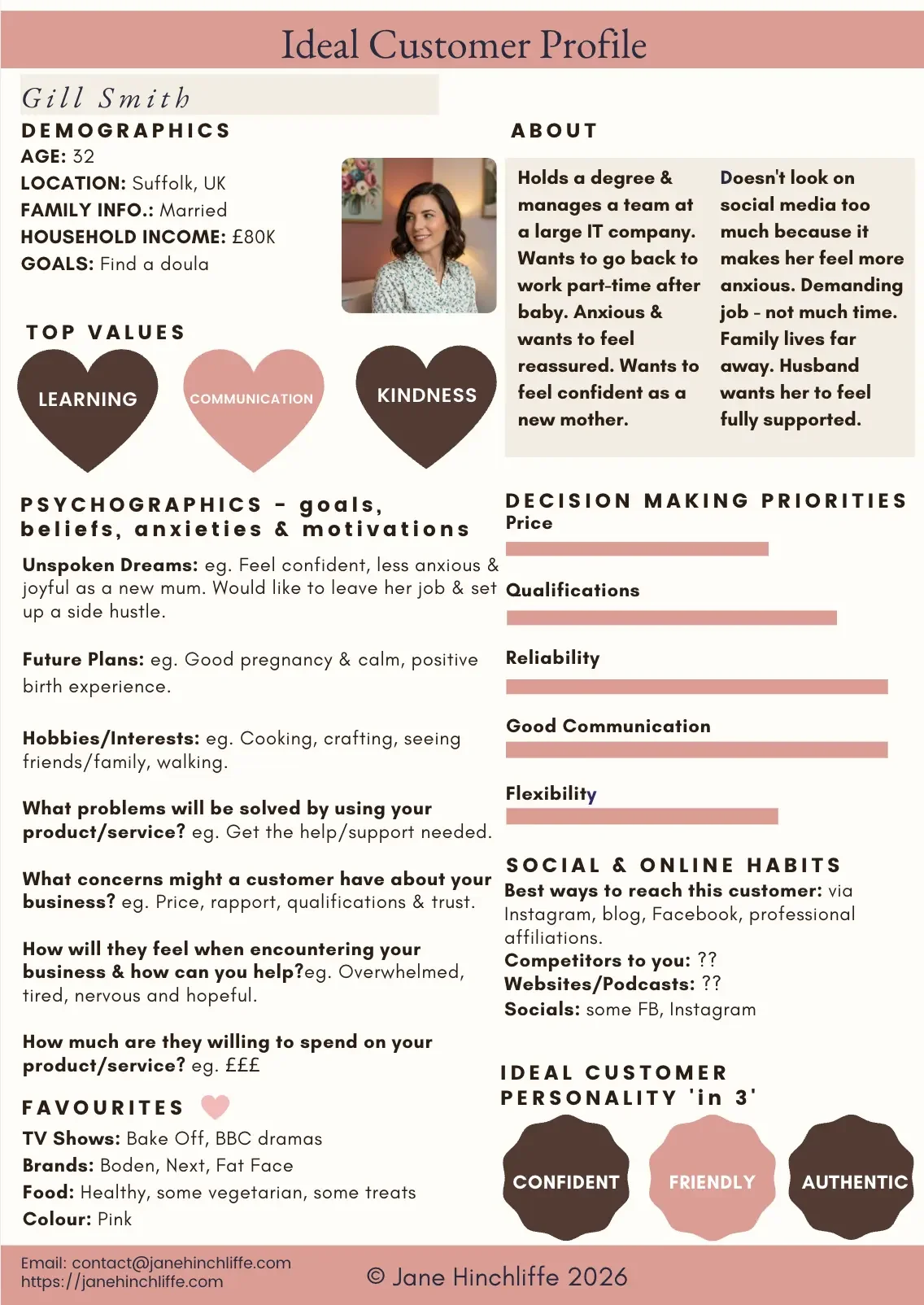
If you're unsure how to "speak" to your audience, read Why Your Brand Voice Matters. And if you're still working out the particulars of your ideal client, grab my free Ideal Customer Profile Canva Template — it'll save you a fair bit of head-scratching.
If working keywords into your copy without it sounding stiff feels tricky, SEO Space* is the jargon-free tool I use and recommend for exactly that.
Heads up — some of the links below are affiliate links, which means I may earn a small commission if you use them, at no extra cost to you. I only ever share tools I genuinely use or recommend.
5. Contact Forms: Simplifying How People Reach You
A well-designed contact form makes it easy — properly easy — for potential clients to get in touch. Keep your forms short and to the point, use clear calls to action, and make sure they're mobile-friendly, since most of your visitors will likely be on their phone.
Worth knowing: the average conversion rate for a contact form submission on a B2B website sits around 2.4%, with high performers hitting 5%+ (Source: Solve.co.uk, 2026). If your form's clunky, slow, or buried three clicks deep, you could be missing out on easy enquiries that were right there for the taking.
Test your forms regularly to make sure they're actually working — a broken contact form is one of those quietly costly problems that can go unnoticed for months.

Client portfolio - Web Design and Brand Creation
FAQs
-
It depends on scope, but a full custom Squarespace build typically takes several weeks from strategy through to launch, while a streamlined build (like my 3-Day Website) can be done far quicker if you're after something simpler and faster to launch.
-
Not always — sometimes a few strategic tweaks (navigation, contact forms, page speed) make a bigger difference than starting from scratch. A Web Audit Service is a good way to find out exactly what's worth fixing before committing to a full rebuild.
-
Honestly, there isn't one — they work together. A stunning design with a broken contact form still loses you enquiries; brilliant content on a confusing, hard-to-navigate site still loses visitors. That's why it's a checklist, not a single fix.
-
Yes — the principles (navigation, brand identity, content, contact forms, hard-working performance) apply to any website platform. The specifics of how you implement them will vary by platform, which is exactly why my Web Audit Service covers all platforms, not just Squarespace.
-
At minimum, once a year — more often if your business, services, or offers have changed significantly. Websites aren't "set and forget"; they need the occasional gentle tend, much like a garden.
The Takeaway:
Your website is often the very first impression a potential client has of your business — and as that 0.05-second stat above shows, they've made up their mind before they've even properly read a word.
By focusing on these five elements — a hard-working foundation, clear navigation, a strong visual identity, content that speaks to your ideal client, and contact forms that actually work — you'll have a website that's professional, easy to use, and built to convert visitors into enquiries.
Don't forget to grab your free 5-Step Web Design Checklist above ⬆️ — it's a handy, 12-page companion to everything covered here.
If you'd rather have a second pair of expert eyes on your website than tick the boxes solo, that's exactly what my Web Audit Service is for — available for Squarespace and other platforms. Or if you know you're ready for a proper plan, book a Web Strategy Session and let's map it out together.
Thanks for being here, and if you’d like more tips, tools, and tricks [without the overwhelm], to help YOU grow your small business, I’d love to have you join my twice-monthly HeartBiz 💌 Letter.
Subscribe here for free downloads: Uncover Your Unique Selling Proposition USP, Ideal Customer editable Canva Template, and an SEO Checklist for Squarespace (or other platforms).